Every cyclist should know the basic road signs to correctly interpret signals on the street and move safely in road traffic. This article is a comprehensive guide to the most important road signs for cyclists – knowledge that is mandatory and helps to avoid dangerous situations.
BECOME A COURIER
Work and earn right away!




What are bicycle signs and why are they important?
Road signs for cyclists are symbols placed on streets that inform cyclists about the rules of movement, available routes, and hazards. A bicycle, as a vehicle participating in road traffic, is subject to the same rules and regulations as all other vehicles. Lack of knowledge of bicycle signs may lead to accidents, as well as financial penalties imposed by officers. Road signs for cyclists include mandatory, prohibition, information, and warning signs, each with a different shape and meaning.
The Polish “Road Traffic Law” Act precisely defines cyclists’ duties in regard to road signs. Cyclists are required to obey them just as car drivers do. Therefore, learning these signs is the first step to road safety and fully participating in traffic.
Mandatory signs for cyclists – required riding signs
Mandatory signs have a circular shape, blue background, and white symbols. These signs require cyclists to perform certain actions—that is, things they must do. Below I describe the most important mandatory signs that every cyclist encounters on the road.
Bicycle Path Sign (C-13)
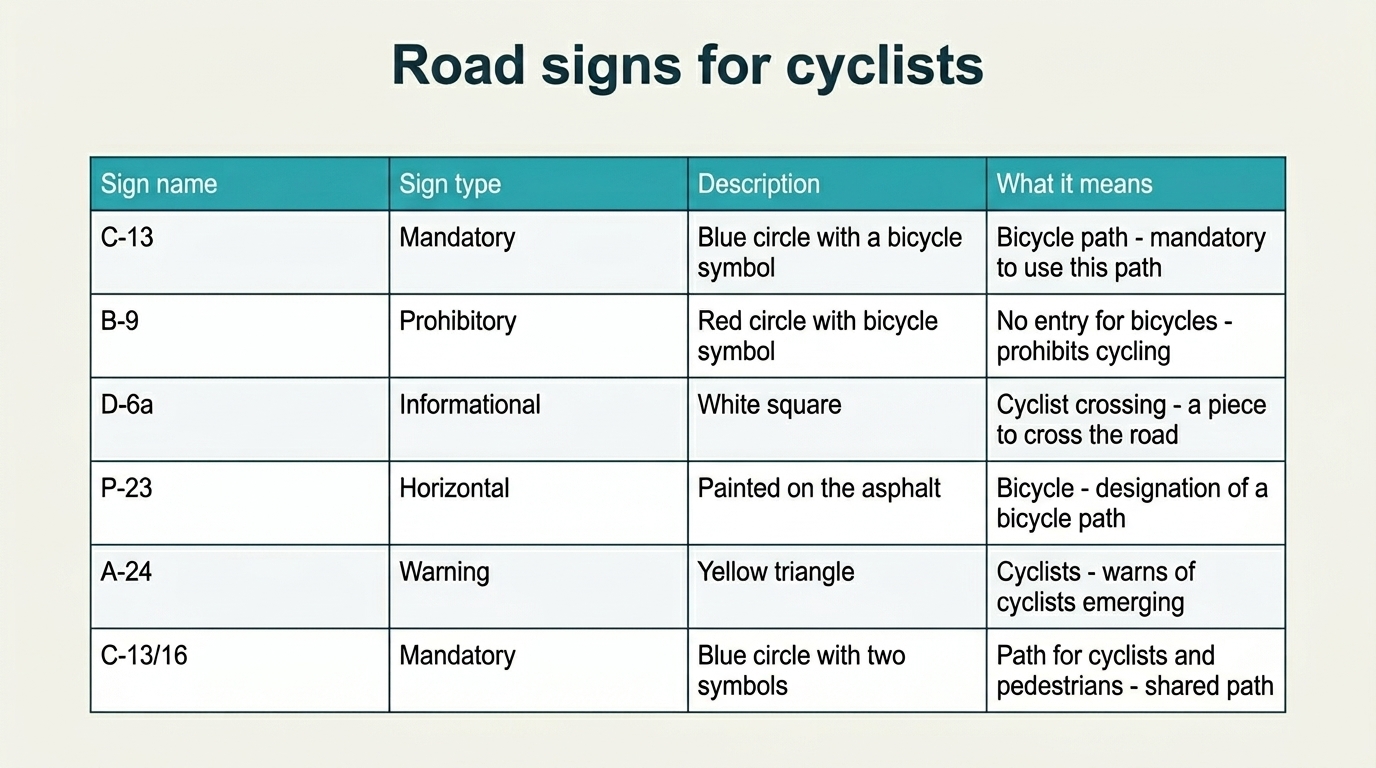
The C-13 sign is one of the most common signs for cyclists. A cyclist is required to use a bicycle path if it is designated for the direction they are traveling or intend to turn. This means that when you see this sign, you cannot ride on the sidewalk or roadway if a bike path is next to it. The P-23 horizontal markings (bicycle) confirm the designation of a bike path on the asphalt. A bicycle path is a separate lane of land designated specifically for bicycle traffic, separated from car and pedestrian traffic.
The C-13a sign indicates the end of a bicycle path—when you see it, it means the bike path ends and you need to change your route or move onto the roadway, following the applicable rules there.
Bicycle and Pedestrian Path Sign (C-13/16)
This sign indicates a shared path for bicycles and pedestrians. It features symbols of both a bicycle and a pedestrian. When the symbols are separated by a vertical line, it means cyclists and pedestrians use different sides of the path. When the line is horizontal, all traffic participants may use the entire width of the path. On a shared path, a cyclist must be especially cautious and yield to pedestrians—the rules here are clear.

Prohibition signs – entry is forbidden
Prohibition signs have a circular shape and a red-and-white color scheme, and their main task is to prohibit certain actions. Every cyclist should know what the following prohibition signs mean.
Bicycles Prohibited Sign (B-9)
The B-9 sign clearly prohibits bicycles from entering. It is typically placed on expressways, highways, and streets with heavy traffic or high permitted speed, which pose a danger to cyclists. This sign indicates that the road is not safe or available for cyclists. If you see this sign, you must find an alternative route, often indicated by bicycle trail signs.
No Entry and No Vehicles Signs (B-1 and B-2)
The B-1 sign (no vehicles in both directions) and B-2 sign (no entry) prohibit all vehicles, including bicycles, from entering. However, there may be T-22 plaques below the signs which indicate an exception—that the prohibition does not apply to single-track bicycles. In such situations, cyclists are allowed to enter the road. This is an important detail that many people overlook.
No Entry for Cycle Trailers Sign (B-11)
This sign prohibits multi-track bicycles (cycle trailers) from entering. It is usually placed on roads with heavy traffic, where such vehicles may impede traffic flow and pose a safety risk to all users.
Information signs – crossings and special routes
Informational signs have a square or rectangle shape, usually in blue-and-white or black-and-white colors. They inform cyclists about special places such as crossings or paths for pedestrians and cyclists.
Cyclist Crossing Sign (D-6a)
A cyclist crossing is a place where a cyclist can cross the road (carriageway). A cyclist who is directly on the crossing has the right of way over vehicles, but not before entering the crossing. Drivers approaching this sign are required to slow down and yield to cyclists already on the crossing.
The P-11 (horizontal) marking indicates the correct crossing on the asphalt, usually with white lines across the road.
Pedestrian Crossing and Bicycle Crossing Sign (D-6b)
The D-6b combination indicates a shared crossing for pedestrians and cyclists. Drivers must slow down and yield the right of way to both pedestrians and cyclists who may be present there.

Warning signs – protect yourself against dangers
Warning signs have a triangular shape, yellow background with a red border, and a black symbol. They warn of potential hazards on the road.
Cyclists Sign (A-24)
The A-24 warning sign informs drivers and other road users that cyclists exiting a bicycle path may appear on the roadway. This sign is placed where a bike path meets the roadway or where cyclists may unexpectedly enter a car lane. Every road user should slow down and be extra cautious in these locations.
Similarly, the A-7 sign (yield) may accompany a bicycle crossing, notifying drivers that they must yield to cyclists crossing the road.
Horizontal road markings – signs on the asphalt
Horizontal markings are symbols or lines painted directly on the roadway or bike path. They are as important as vertical signs.
P-23 – Bicycle
The P-23 road marking, a bicycle symbol painted on the asphalt, indicates a road designated for bicycles. If you see this symbol on the road, you know you are using the correct route.
P-27 – Bicycle direction and lane
This marking indicates the organization of bicycle traffic – it shows the direction and lane that cyclists should follow on that stretch of the road. It is especially useful at intersections and junctions.
Cyclist responsibilities – what you need to know
A cyclist is required to use the bike path, bike lane, or pedestrian and bicycle path if these are designated for the direction they are traveling. This is not a choice – it is the law. Exceptions to this rule occur when the cyclist is looking after a child under 10 riding a bike, or when the sidewalk is at least 2 meters wide and located next to a road where the speed limit is more than 50 km/h.
The cyclist also has obligations regarding maneuvers. Before every turn or lane change they must signal their intention in advance by extending their arm to the side corresponding to the direction of movement. This should be done at least a few seconds before the maneuver, while also making sure that no vehicle from behind is about to overtake.
Prohibitions for cyclists also include riding without holding at least one hand on the handlebars, riding while intoxicated, cycling under the influence of alcohol, holding onto vehicles, overtaking vehicles at pedestrian crossings or bicycle crossings (except when directed by traffic), and riding next to another road user without justification.

Cyclist’s right of way – when does a cyclist have the right of way
The issue of a cyclist’s right of way on the road is often misunderstood and misinterpreted. A cyclist has the right of way over a vehicle only in specific situations – when they are already directly on the bicycle crossing or when a vehicle is turning into a side road and the cyclist is going straight.
When approaching a bicycle crossing, the cyclist does not yet have the right of way – they must be alert and make sure the road is clear. On the other hand, the driver approaching the bicycle crossing is required to exercise particular caution and reduce speed. When the cyclist enters the crossing, they then have the right of way.
Another situation in which the cyclist has the right of way is when a vehicle leaves a bicycle path or crosses a bicycle path – in this case, the cyclist moving on the bike path has the right of way over the vehicle.
Summary – safe cycling
Traffic signs for cyclists are an essential part of every road user’s knowledge. Mandatory signs include mandatory signs (C-13 – bike path), prohibition signs (B-9 – no entry for bicycles), informational signs (D-6a – bicycle crossing), and warning signs (A-24 – cyclists). Each of these signs carries important information that can save your life.
Remember: following traffic signs, proper signaling of maneuvers, wearing a helmet, and wearing clothing visible on the road are the foundations of cyclist safety. If you are a new cyclist, take the time to get acquainted with these signs – it will be the best investment in your safety. Bicycle signs make road traffic more predictable and safer for all its users.
Are you sure you know all the road signs for cyclists? If you want to work as a courier for Glovo, Wolt, Uber Eats, take another look at our comparison table and make sure you understand each of them. Safe riding!
BECOME A COURIER
Work and earn right away!