The question of when does a cyclist have the right of way at a bicycle crossing is one of the most common uncertainties in road traffic. The answer is not entirely straightforward – everything depends on the exact situation we are in. A cyclist only has the right of way under specific conditions defined by the Road Traffic Law, and a lack of knowledge about these conditions leads to many dangerous situations on the road. In this article, we explain exactly when a cyclist has right of way and when they must yield to ensure their own safety and that of other road users.
Does a cyclist have the right of way at a bicycle crossing? The answer according to legal sources
To answer this question, we first have to distinguish between two situations: a cyclist approaching the crossing and a cyclist already on it. This distinction is absolutely crucial for understanding the regulations because it completely changes the legal situation.
Cyclist approaching the crossing – no right of way
Many people mistakenly believe that a cyclist approaching a bicycle crossing already has the right of way. The regulations state otherwise. A cyclist approaching a bicycle crossing does not have the right of way over vehicles traveling on the road. This is clearly defined in Article 27 paragraph 1 of the Road Traffic Law, which refers to a cyclist already on the crossing, not one approaching it. This change happened much later than those concerning pedestrians – only in recent years was the law changed so that pedestrians gain right of way when entering a pedestrian crossing, but such a change was not introduced for cyclists.
A cyclist approaching the crossing must therefore exercise particular caution and make sure that the road is completely clear. If a vehicle is approaching the crossing, the cyclist should wait until it is safe to cross. Regulations prohibit entering the crossing ‘just in case’ or ‘on a chance’ – there must be certainty that vehicles have stopped.
Cyclist already on the crossing – full right of way
The situation changes dramatically once the cyclist enters the bicycle crossing. At the moment they are on the crossing, they gain full right of way over the vehicle from the road. The driver approaching the crossing is then required to exercise particular caution and yield the right of way. It sounds simple, but in practice, this leads to many conflicts and misunderstandings on the road.
Courts in Poland have repeatedly clarified this situation. A ruling of the District Court in Poznań states that entering a crossing in front of an oncoming car is comparable to a pedestrian darting onto the roadway – it is not permitted and exposes the cyclist to liability for causing an accident. The cyclist must first ensure that vehicles have stopped or have clearly slowed down.


Right of way on various types of roads and bicycle crossings – comparative table

When does a cyclist have right of way? Specific situations
The regulations specify several specific situations in which a cyclist is guaranteed the right of way. Remembering them is essential for safe riding both in the city and outside it.
- Bicycle crossing – vehicle turning into a side road
Article 27 paragraph 1a of the Road Traffic Law states that the driver of a vehicle turning into a side road is required to yield the right of way to a cyclist going straight. This situation applies when a cyclist is riding on a bicycle path, a bicycle lane, or another part of the road, and a vehicle wants to turn across it. In such a case, the cyclist has right of way even before entering the crossing – they do not have to wait until they are on the crossing.
This situation is quite common in cities where bike paths cross intersections. A driver turning right or left must make sure that the bike path is clear. This right of way applies to cyclists regardless of whether they are already directly on the bicycle crossing.
- Bicycle path – vehicle crossing it
When passing through a bicycle path (Article 27 paragraph 3 of the Road Traffic Law), a vehicle must yield the right of way to the cyclist. If you are driving a car and need to cross a bicycle path, you must make sure there are no cyclists and yield the right of way to them. This applies to situations where the bicycle path intersects the road and you want to cross it.
- Sign A-7 “Yield” before the crossing
If there is a A-7 “Yield” sign (or sometimes B-20 “Stop”) before a bicycle crossing, the situation changes drastically. A vehicle coming from a secondary road onto a priority road must yield the right of way to a cyclist approaching the crossing, not only when the cyclist is on it. This exception means that in this particular situation, a cyclist can feel safe when approaching the crossing.
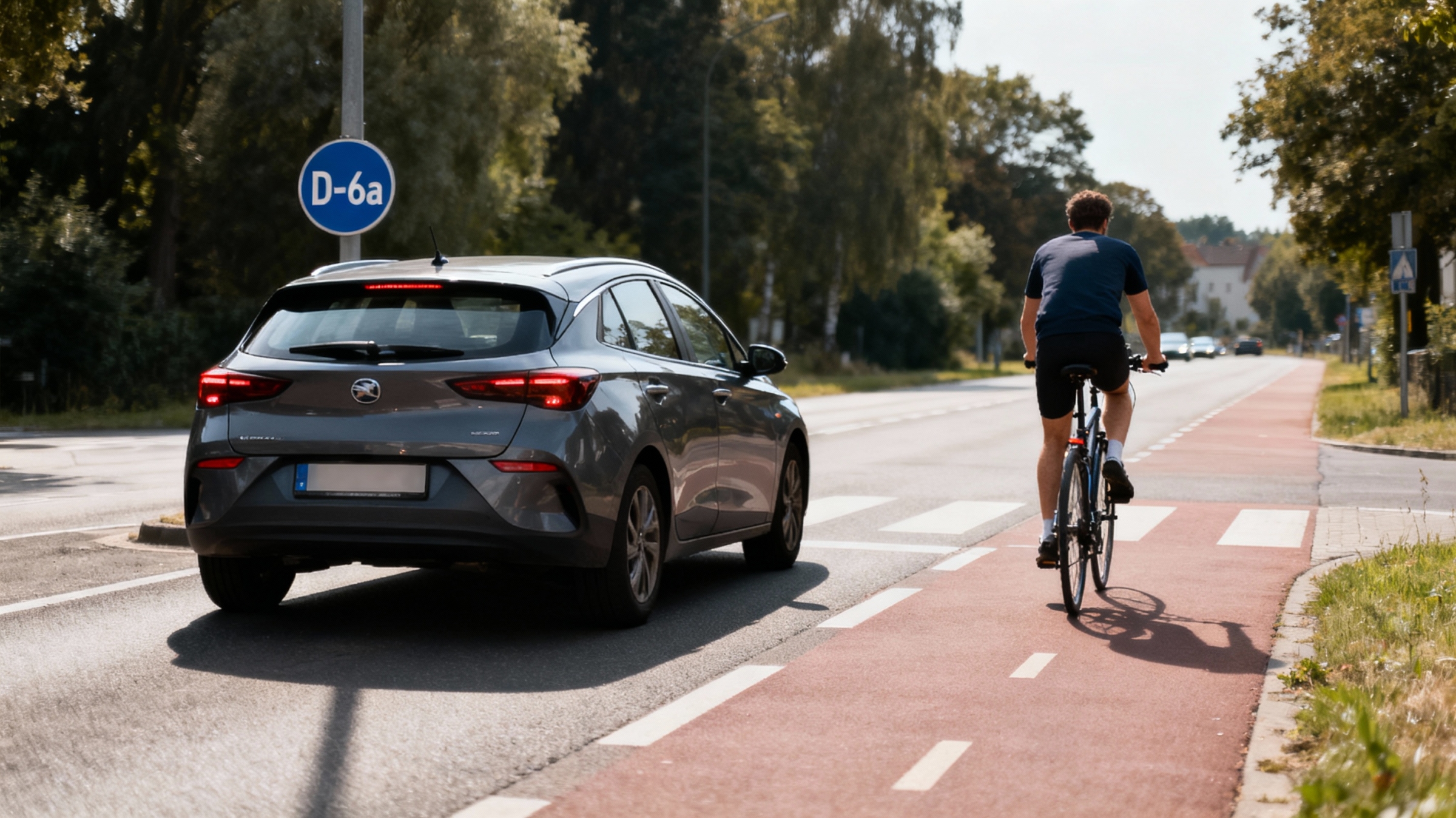
Pedestrian and bicycle path – hierarchy of right of way
Pedestrian and bicycle path is a special type of route intended for both groups of users. Here, the hierarchy of right of way is very important and worth understanding.
- Cyclist versus vehicle on shared road
On a pedestrian and bicycle path, when a vehicle crosses it, the cyclist has right of way. The vehicle must yield. However, the situation becomes more complicated when a vehicle wants to enter from a secondary road – then Article 25 of the Road Traffic Code (right of way) as well as road signs apply.
- Cyclist versus pedestrian on a shared path
On a shared path for pedestrians and bicycles, the hierarchy is clearly defined: pedestrians have priority over cyclists. A cyclist using a shared path for bicycles and pedestrians must exercise particular caution and yield to pedestrians. This is very important, as many people are unaware of it and put pedestrians at risk.
- Cyclist at crosswalk – dismounting required
The issue of cyclists at pedestrian crosswalks sparks a lot of controversy, but the regulations are clear: a cyclist must dismount before entering a crosswalk and walk the bike across. Article 26 of the Road Code expressly prohibits riding a vehicle across a pedestrian crossing. A cyclist is treated as a vehicle operator, not as a pedestrian.
- When does a cyclist have the right of way at a crosswalk?
A cyclist riding a bicycle does not have the right of way at a crosswalk – dismounting is mandatory. The only exception is children under the age of 10, who, according to the definition in the Traffic Law, are treated as pedestrians rather than cyclists. A child may ride across the crosswalk without dismounting if a guardian is walking beside them.
- Fine for riding a bicycle across a crosswalk
Riding a bicycle across a crosswalk carries a fine – from 50 to 100 PLN. Although the amount isn’t very high, it’s important to remember that the regulations are intended to increase safety, not just to inconvenience cyclists.
- Bicycle crossing – different from a pedestrian crossing
It’s important to clearly distinguish a pedestrian crossing (crosswalk) from a bicycle crossing (marked with sign P-11). A bicycle crossing is a place designated for bicycles, where the cyclist has the right and the obligation to ride across. If there is a bicycle crossing next to a pedestrian crosswalk, the cyclist should use it.
Pedestrian crossing on a bicycle path – who has the right of way?
The situation becomes more complicated when a pedestrian crossing intersects a bike path. The rules here are very clear: the pedestrian has the right of way.
Crosswalk with D-6 sign – pedestrian has priority
If the pedestrian crossing intersecting the bike path is marked with D-6 vertical sign, the pedestrian has absolute priority. The cyclist must immediately slow down and, if necessary, get off the bike and walk it, waiting until the pedestrian has passed. This right of way applies to the pedestrian already as they approach the crossing, not just when standing on it.
Crosswalk without D-6 sign – exception
If there is a painted crosswalk (zebra) on the bike path but without the vertical D-6 sign, the situation changes. In such a case, the cyclist has the right of way. However, it’s important to remember that this is an exception to the rule, and many cyclists and pedestrians don’t know this, which can lead to dangerous situations.
Bicycle path – regulations and right of way
On a bicycle path, the cyclist has priority over vehicles. This is obvious, but worth repeating. If you are riding on a bike path, vehicles must yield the right of way to you. The situation changes only when the vehicle is allowed to cross the path (as with a bicycle road) – then the rules for that particular type of intersection apply.
Cyclist obligations – what do you need to remember
To ride safely, remember your responsibilities as a cyclist:
- Always exercise particular caution when approaching a bike crossing
- Make sure the way is clear before entering the crossing
- Dismount your bike before entering the pedestrian crossing (unless you are under 10 years old)
- Yield to pedestrians on shared paths and at pedestrian crossings on the bicycle path
- Signal your maneuvers by extending your hand
- Observe your entire surroundings and be prepared for unexpected actions from other road users
Driver’s duties – what you should know
The car driver also has specific duties:
- Exercise extreme caution when approaching a bicycle crossing
- Yield to cyclists who are already on the crossing
- Give way when turning onto a side road where a cyclist is present
- Do not enter the bicycle path without making sure it is clear
- Watch your surroundings and expect cyclists who may be coming out from a bike path
Summary – safe riding at crossings
Does a cyclist have the right of way at a bike crossing? The answer is: it depends. A cyclist has priority when they are already on it, but not when approaching it. This fundamental distinction can save your life. Also remember the right-of-way hierarchy on shared pedestrian routes, the requirement to dismount at crosswalks, and the rules regarding intersections. By knowing and respecting these rules, both you and other road users will move more safely. This is especially important if you want to work as a courier for Glovo, Wolt, Stuart or Bolt Food.
Do you now understand the right-of-way rules at a bicycle crossing? Share this knowledge with other cyclists and drivers – every person who knows these rules is one less person at risk of an accident!