It may seem that “red” is an obvious matter, yet drivers still take risks because they’re late or “it was still yellow.” The problem is, the consequences can be much greater than momentary stress: high fines, penalty points, and a ticket from a camera, which may arrive later. Below, you’ll find a practical cheat sheet: what is the fine for running a red light, how many points, how the recorders work, and what about running a yellow light.

BECOME
A TAXI DRIVER
Work and earn right away!



Fine for Running a Red Light – What Does It Depend On?
The penalty amount depends on exactly what the driver did. It’s judged differently if you drive through an intersection on a red light than, for example, entering a railroad crossing at a red signal. It also matters whether the violation was caught by a patrol or a device (a red-light camera ticket). As a driver, you should know these key points.
The most important factors:
- Location of the infraction (intersection, railroad crossing, crossing with signals)
- Manner of detection (traffic stop vs. camera recorder)
- Circumstances (e.g., creating a hazard, failing to yield right of way)
New Schedule of Fines
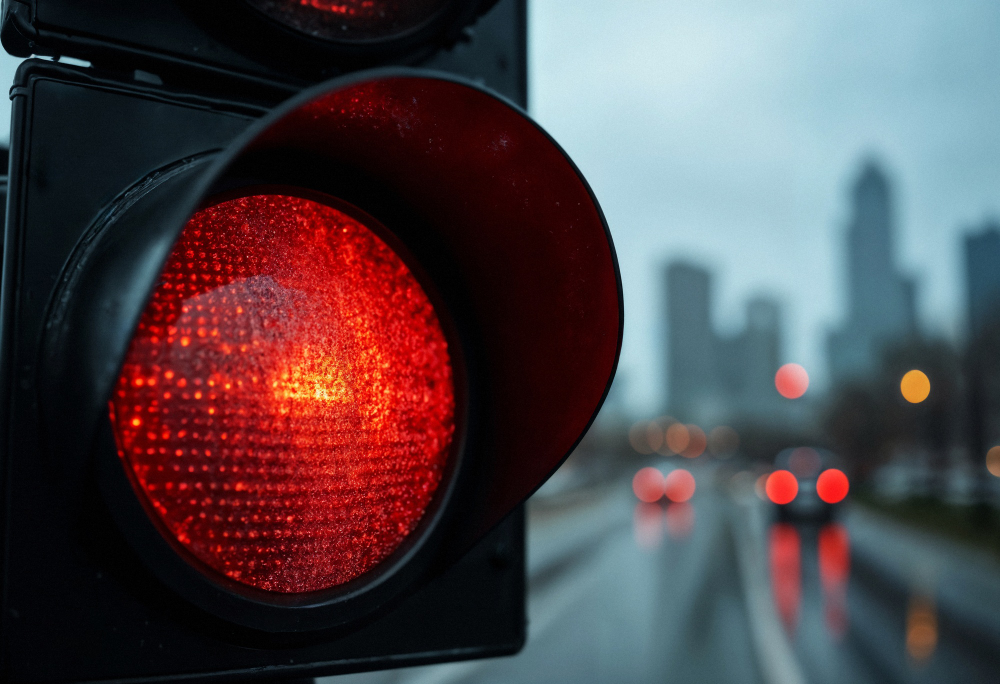
Drivers often ask about the new schedule of fines for running a red light, as the rates have increased significantly in recent years. There’s no place here for “symbolic” amounts – a fine for running a red light can be severe, and penalty points can quickly bring you close to the limit. In 2026, the fine for running a red light at an intersection is 500 PLN and 15 penalty points. If running a red light results in a collision, the fine may increase to 1500 PLN.
If the police determine that there was a gross threat to safety, the case may go to court, and the financial penalty can reach even 30,000 PLN. Meanwhile, the fine for entering a railroad crossing at a red light is 2,000 PLN, and for repeat offenses (within 2 years) – 4,000 PLN.
If you are already a taxi driver or are considering working as a driver on the most popular apps like Bolt, Uber, and Freenow, join us!
Table: Most Common Situations and Consequences
The table below is for practical orientation (details always depend on how the offense is classified by the police or described in the notice):
| Situation | What the driver faces | What’s worth knowing |
|---|---|---|
| Running a red light at an intersection | Fine + points | Most often applies to “entering past the signal” at red |
| Red-light camera fine | Fine (usually + points if the driver is identified) | Depends on the procedure and the response from the vehicle owner |
| Running a yellow light | May end in a fine | If entry was possible safely—usually ok, but there are some disputed cases |
| Fine for entering a railroad crossing at a red light | Severe penalty + points | This is one of the most seriously treated offenses |
How Many Points for Running a Red Light?
The question “how many points for running a red light” comes up very often, because it’s the points (not just the fine) that tend to be the biggest issue for daily drivers. In practice, one such offense can “make a difference” for a driver who does a lot of city driving and already has several minor offenses on their record.
Tip: if you receive a notice after a violation recorded by a device, pay attention to whether the case concerns identifying the driver and how the offense is described. This affects the final fine and points.
What Does a Red-Light Recorder Look Like?
Many people think of a “speed camera,” but red-light recorders are usually a set of cameras (often on a mast or boom) working with sensors in the road or image analysis. The system “knows” when the traffic light is red and records vehicles crossing the stop line and passing through the intersection area.
How to recognize it (most often):
- Cameras aimed at approach lanes and the intersection area
- Housings near traffic signals or on structures above the road
- Sometimes additional lighting/system elements nearby
Where are cameras recording running a red light located?
The question “where are cameras recording running a red light located” is understandable, but remember: their locations can change, and the point isn’t to “avoid” them but to improve safety. You’ll most often find them:
- At large, multi-lane intersections
- In areas with a high number of collisions and accidents
- Where there have been frequent violations of right of way
Red light ticket from a camera – how long does it take to arrive?
How long does it take to receive a ticket for running a red light? It depends on document processing, who operates the system, and whether the driver needs to be identified. Sometimes it’s a matter of a few weeks, sometimes longer (for example, when correspondence and explanations are needed).
What to do if you receive a letter:
- Check the date, location, and description of the incident
- Consider whether you remember the situation (and if someone else could have been driving)
- Watch the response deadlines, as not replying may make the situation worse
Running a red light, or “it was still yellow”
Most disputes arise from the grey area between red and yellow. Passing through on a yellow light is generally allowed only when it’s not possible to stop safely before the signal. However, if a driver “steps on the gas” to make it and the light turns red as they cross the line, the risk of a fine increases.
A simple everyday rule: if you see yellow and can actually stop safely without hard braking or putting the car behind you at risk, brake.
Summary
Running a red light is one of those offenses that can cost you a lot of money, points, and nerves—especially when a red light ticket from a camera comes back to haunt you. If you want to drive more calmly in the city, set yourself a simple rule: treat yellow as “stop,” unless stopping would be dangerous.
Want more practical tips for drivers like this? Check out Jazda na 5.o and explore our guides on traffic regulations and safe driving.

BECOME
A TAXI DRIVER
Work and earn right away!