Why is the correct tire pressure for bicycles so important?
Proper tire pressure is the foundation of safe and comfortable cycling. Too low pressure causes increased rolling resistance, faster tire wear, and reduced grip, while in extreme cases, it can damage the rim. On the other hand, too high pressure decreases grip, negatively affects riding comfort, and can lead to a tire blowout on rough surfaces. That’s why it’s important to know the rules of proper inflation and adjust the pressure to your needs.


Pressure units – bar, PSI, atmospheres
Before we get to specific numbers, it’s worth knowing which units are used. 1 bar is about 14.50 PSI, and 1 atmosphere (atm) is 1.01325 bar. Devices and tires may use ranges marked in different units, so it’s good to be familiar with conversions. The most common conversions are:
- 2 bar = 29 PSI
- 3 bar = 44 PSI
- 3.5 bar = 50 PSI
- 4.8 bar = 70 PSI
- 5.5 bar = 80 PSI
- 6 bar = 87 PSI
- 7 bar = 102 PSI
- 8 bar = 116 PSI
Tires usually show minimum and maximum ranges (e.g., min 2.5 bar, max 5.0 bar). Never inflate below the minimum or above the maximum value, as this can damage the wheel or pose a safety risk.
Pressure table for different types of bicycles
Bicycle tire pressure – an overview for different types of bikes

Road bike — highest pressure
For road bikes, the pressure ranges from 6 to 9 bar (87–130 PSI). High pressure minimizes rolling resistance, allows for higher speeds, and makes riding on asphalt easier. Professional riders sometimes inflate up to 15 bar, but we don’t recommend this for regular rides. Higher pressure means less grip on uneven asphalt and no shock absorption. We recommend starting with 7–8 bar and adjusting to your preference.
Mountain bike (MTB) — lowest pressure
Mountain bikes run at 1.5–2.5 bar (22–36 PSI). Lower pressure provides better grip on narrow trails, naturally absorbs terrain bumps, and reduces the risk of punctures. In tubeless systems, you can lower the pressure even to 1.0–1.8 bar, which further improves traction. Remember that too low pressure can damage the rim, and on demanding terrain, the risk is high.
Trekking bike — a universal solution
Trekking bikes, ideal for long trips, require a pressure of 3–4.5 bar (43–65 PSI). This is a compromise between comfort and efficiency. On asphalt, you can inflate closer to the higher values (about 4–4.5 bar), while on rough paths reduce to 3 bar. This flexibility makes the trekking bike a universal vehicle for various surfaces.
City bike — comfort and stability
City bikes typically use a pressure of 3–5 bar (43–72 PSI). Higher values (4.5–5 bar) support riders with higher weight or carrying luggage, while lower (3–3.5 bar) provide more comfort on cobbled streets. Many city bikes have wider tires (usually 35–40 mm), which naturally work at lower pressure.
Gravel bike — terrain variability
Gravel bikes are a mix between road and mountain bikes. The pressure ranges from 2.5–4 bar (36–58 PSI) and depends on tire width. Narrower tires (35 mm) are inflated to 3.5–4 bar, while wider ones (40–45 mm) work better at 2.5–3.5 bar. You can increase the pressure on asphalt and lower it on gravel for better traction.

Pressure and Cyclist’s Weight — Practical Tables
The user’s weight is a key factor. Heavier cyclists need higher pressure to avoid excessive tire sag. Approximate values are given below:
Road bike (23–28 mm tires):
- Up to 50 kg: 5.8–6.0 bar
- 50–70 kg: 6.2–6.6 bar
- 70–90 kg: 7.0–7.6 bar
- Over 90 kg: 7.9+ bar
MTB bike (tubeless):
- Up to 60 kg: 1.5–1.8 bar
- 60–80 kg: 1.8–2.2 bar
- 80–100 kg: 2.2–2.5 bar
Trekking bike:
- 60–80 kg: 3.5–4.0 bar
- 80–100 kg: 4.0–4.5 bar
Always follow the range given on the tires and adjust it to your own comfort. If you feel less confident, start with lower values and gradually increase.
Does Tire Width Matter?
Absolutely! A narrower tire (e.g., 23 mm on a road bike) requires higher pressure than a wide one (e.g., 40 mm on a gravel bike). The rule is simple: the narrower the tire, the higher the pressure. That’s why a road bike is inflated to 6–9 bars, while a mountain bike is set to 1.5–2.5 bars. The manufacturer always provides the recommended range—it’s worth knowing and following it.
How to Read Tire Information?
On the side of every tire you will find a label in the format: min 2.5 bar (36 PSI) – max 5.0 bar (73 PSI). These are your guidelines. Never go below the minimum or above the maximum. Before you buy a new pump or inflate for the first time, carefully read these markings. Every tire is different—what works for one brand might not work for another.
Pressure calculator — how is it estimated?
There is no universal calculator, but you can follow these tips:
- Check the manufacturer’s recommendations — written on the tire’s sidewall.
- Find your weight — in the tables above.
- Choose the surface type — asphalt requires higher pressure, rough terrain lower.
- Test and adjust — every bike and every cyclist is a different combination. Start in the middle of the range and change if something doesn’t feel right.
Manufacturers like Giant or Trek offer calculators on their websites—it’s worth checking there for precise calculations for your specific model.

Common mistakes when inflating bicycles
The most common mistake is playing the lottery instead of systematically checking. Many people pump until the tire bursts or feels hard, instead of measuring the pressure with a gauge. The second mistake is ignoring the manufacturer’s recommendations — if the manufacturer says “max 4.5 bar” and you pump to 5.5, you’re taking a risk. The third is forgetting about seasonality — in winter, pressure naturally drops, so it’s worth checking it more often than in the summer.
Another mistake: assuming that all bikes are the same. A road bike and a mountain bike are completely different worlds. What works for one can spell disaster for the other.
Cooperation with Avalon Logistics
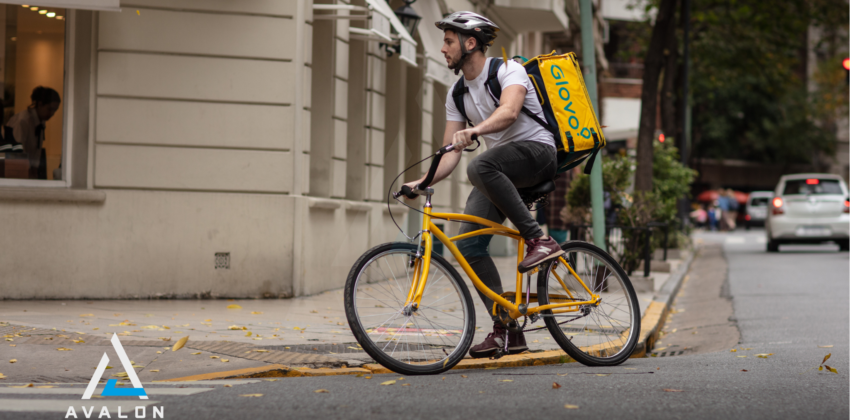
If you are looking for a reliable partner to start working with on apps such as: Glovo, Uber Eats, Wolt, Stuart, Bolt Food, Lisek.App, or Żabka Jush, it’s worth getting to know Avalon Logistics. We have recently established cooperation on courier platforms to ensure fast and safe delivery of your orders. Avalon Logistics specializes in e-commerce logistics and handles both domestic and international shipments. Thanks to this cooperation, you can count on efficient order fulfillment, reliable parcel tracking, and professional service. If you want to learn more about our cooperation or have questions about deliveries, feel free to contact us — we are available to support your business in the cycling industry.
Practical tips to remember
- Use a pressure gauge — don’t rely on feel. Buying a pump with a gauge is the best investment.
- Pump slowly — rushing leads to mistakes and damage.
- Remember the valves — there are two types: Presta (thin, with a locknut) and Dunlop (thicker, without a locknut). An adapter is not always useful.
- Pressure drops in winter — when the temperature drops by 10 °C, pressure drops by about 0.3–0.4 bar. Repeat pumping is normal and necessary.
- Listen to your bike — if you feel the wheels are too hard or too soft, adjust the pressure for comfort.
Summary — how much to inflate your bike?
There is no universal answer, but now you know how to check:
- Road bike: 6–9 bar
- MTB bike: 1.5–2.5 bar
- Trekking bike: 3–4.5 bar
- City bike: 3–5 bar
- Gravel bike: 2.5–4 bar
Always follow the range on the tire, your weight, surface type, and your preferences. Invest in a good pump with a gauge, and cleaning and inflating your bike will become a pleasant ritual instead of a routine chore. A bike with the correct tire pressure ensures safety, comfort, and smooth riding!